

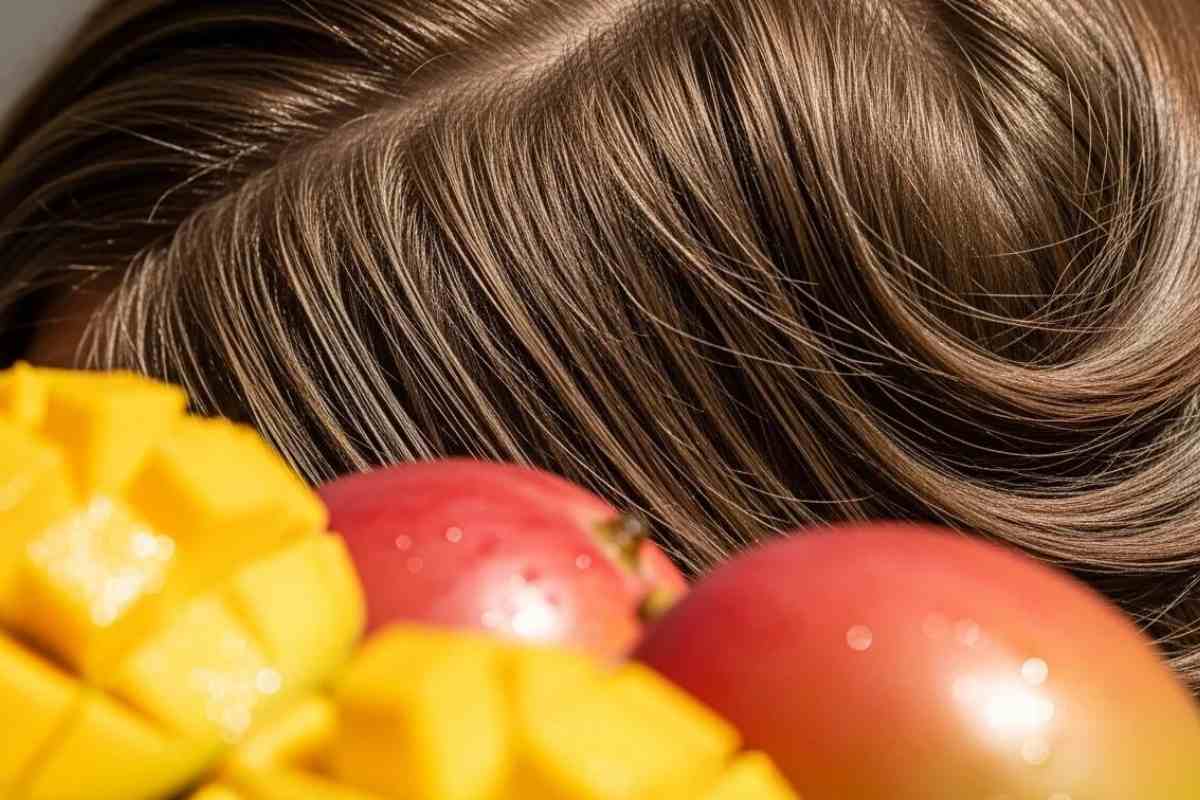
There are unique benefits of mango for hair as it helps to trace elements such as zinc, potassium, and copper, which are necessary for hair health.
Additionally, due to its vitamin A content, beta-carotene, and antioxidants, mangoes are recommended to improve hair and visual health.
Table of Contents
Why Mango Even Matters for Hair
Hair health doesn’t start in your shampoo bottle. It starts in your body.
If your scalp isn’t healthy, if your body lacks nutrients, or if your hair strands are constantly dry and breaking — no serum can magically fix that.
Mango helps in two main ways:
- When you eat it – it nourishes from within.
- When you use mango butter or seed oil – it moisturizes and protects externally.
Let’s break that down.
What’s Inside a Mango That Helps Hair?
Here’s a simple breakdown (no complicated science talk).
| Nutrient | Why Your Hair Likes It |
| Vitamin C | Helps produce collagen, which supports hair structure |
| Vitamin A | Supports scalp health and natural oil balance |
| Vitamin E | Protects from oxidative damage |
| Antioxidants | Reduce stress on hair follicles |
| Natural sugars & water | Provide hydration support |
Vitamin C is especially important because it supports collagen production. Collagen helps keep the skin around your follicles strong. Healthy follicles = stronger hair growth foundation.
Vitamin A supports scalp health. But balance matters. Too much vitamin A can actually cause hair fall — so we’re talking about natural amounts from fruit, not supplements.
And then there’s vitamin E. It helps reduce oxidative stress — which sounds technical, but basically means it protects your hair and scalp from environmental damage.
Does Mango Actually Make Hair Grow Faster?
Let’s be honest here.
No fruit — including mango — is going to make your hair grow 5 inches in a month.
Hair growth depends on:
- Genetics
- Hormones
- Overall nutrition
- Stress levels
- Scalp health
What mango can do is support the conditions needed for healthy growth.
If your body is lacking nutrients, your hair often shows it first. Eating nutrient-rich fruits like mango helps fill those gaps.
So instead of thinking:
“Will mango magically grow my hair?”
Think:
“Can mango help create a healthier environment for my hair to grow?”
That answer is yes.
Mango for Dry and Frizzy Hair
Now this is where mango really impresses me.
Mango butter — which comes from the seed — is rich in fatty acids. It works beautifully for:
- Dry hair
- Heat-damaged strands
- Frizz control
- Dull hair
It’s lighter than shea butter but still deeply nourishing.
When applied to hair, mango butter:
- Smooths the cuticle
- Reduces moisture loss
- Adds shine
- Makes hair feel softer
If your hair feels rough at the ends, mango butter can genuinely help.
Eating Mango for Hair Health
Let’s talk about the internal approach.
When you eat mango, you’re giving your body:
- Hydration
- Natural antioxidants
- Skin-supporting vitamins
Healthy scalp skin supports healthy follicles. And follicles are where hair grows from.
You don’t need to overdo it.
One medium mango a few times a week during season is more than enough.
And no — eating 4 mangoes a day won’t speed things up.
Balance always wins.
Excellent Benefits of Mango for hair
1. Protects hair from dryness
- Due to its texture, mango pulp is considered ideal for softening and protecting hair from dryness problems.
- Prepare a conditioner with a cup of mango puree, one tablespoon of yoghurt, and two egg yolks.
- Apply throughout the hair and leave for 20 minutes.
2. Treats dandruff
- According to popular beliefs, we can treat dandruff with mango thanks to its vitamin A content.
- To take advantage of this, we prepare a mango puree.
- Below it is applied all over the scalp and left to act for 20 to 30 minutes.
3. Prevents premature hair greying
- I recommend preparing a mixture of coconut oil with mango seeds without its outer layer to prevent premature hair greying.
- It is applied all over the hair, left on for 30 minutes, and rinsed off.
- Its properties are ideal for smoothing and protecting hair from problems such as dryness and itchy scalp.
- Prepare a conditioner with a cup of mango puree, one tablespoon of yoghurt, and two egg yolks.
- Apply throughout the hair and leave for 20 minutes.
- We can fight the roughness problem with mango thanks to its high vitamin A content.
4. Reduces hair loss
- Give the inadequate care to the hair, the use of devices that emit heat, and the excess of chemicals in the scalp and cause hair loss.
- There is a wide variety of products, both natural and cosmetic, to treat this problem.
- Among the natural ones, one highly recommended is mango leaves.
- Thanks to their properties, they offer excellent benefits to the hair to reduce hair loss.
5. Strengthens and adds shine to hair
- Mango leaves are widely used and recommended to give strength to hair strands, keep them healthy, and with a natural shine from the roots to the ends.
- Its properties make this product an excellent home remedy for hair and the problems that it may present.
- It helps treat and combat the problems present in the scalp and hair in general.
- We can use mango leaves as an infusion.
- That is, you can place 5 to 8 mango leaves in two cups of boiling water for three minutes and then apply all over the hair and leave it to act without rinsing.
Does Mango Help with Dandruff?
Indirectly — yes.
If your dandruff is caused by dryness, mango-based masks can help by moisturizing the scalp.
But if it’s fungal dandruff, you’ll need medicated treatment. Mango alone won’t cure that.
Who Should Avoid Using Mango on Hair?
Be careful if:
- You have mango allergy
- Your scalp is very oily
- You have open cuts or infections
Always patch test before applying fruit-based masks.
Mango Mask for Hair
Another way to use mango leaves to combat hair loss, strengthen hair follicles, and give hair shine is as follows:
Ingredients:
- 8-10 Mango leaves (washed)
- 1 litre of rum (white)
Preparation:
- In a container with a lid, place the white rum next to the mango leaves, mix well, and close the jar very well.
- You must let it rest for an extended period of 12 days, in a place where it receives sunlight all day.
- When the recommended time has passed, remove all the sheets without leaving any remains.
- At the time of application, you must mix 1/2 cup of the rum mixture with 1/2 cup of warm water and apply it all over the hair, especially the scalp.
- Massage gently and leave for an hour; repeat the procedure three times a week until you notice improvements.
Simple Routine Using Mango for Hair
Here’s an easy weekly plan:
| Day | What to Do |
| 2–3 times/week | Eat fresh mango (moderate portion) |
| Once/week | Mango yogurt hair mask |
| Once/week | Mango butter pre-wash treatment |
| Daily | Gentle scalp massage (no oil needed) |
Simple hair treatment with mango extract
Ingredients:
- A handful of mango extract
- 2-3 cups of water.
Preparation:
- Bring the water together with the mango leaves to a simmer.
- Cover and boil for at least 5 minutes.
- Remove from the heat, remove the leaves and discard them so that only the infusion remains.
- When it is cold, it will be ready to apply.
Application:
- To apply mango leaves’ infusion leaves, you can choose to pour it into a spray bottle to facilitate the process directly on the scalp.
- In both cases, it is advisable to massage the scalp for a few minutes to promote circulation in the area.
- And also to facilitate the absorption of the mango leaf water’s vitamins.
- Leave the infusion to act without rinsing.
Also Read: Cooling Body Wash – Homemade Recipe and Best Product for Cooling Body Wash
- READ MORE:- gernalhealth